A confident Invisalign result is rarely about simply putting in clear aligners and waiting for teeth to move. This Invisalign treatment results case study shows how personalized planning, consistent wear, and careful clinical monitoring can improve crowding, bite balance, and smile appearance while protecting long-term oral health.
The patient described below is a representative composite based on common adult treatment needs. Every smile, bite, and treatment timeline is different, which is why an in-person orthodontic evaluation is essential before making decisions about clear aligner treatment.
Invisalign Treatment Results Case Study: The Starting Point
Our composite patient was a 34-year-old professional who had avoided smiling broadly in photos for years. Her main concern was noticeable crowding of the lower front teeth, along with one upper lateral incisor that sat slightly behind the neighboring teeth. She also noticed that her upper front teeth overlapped the lower teeth more than she wanted.
Her goals were straightforward: straighten the visible teeth, improve the overall symmetry of her smile, and avoid brackets and wires during a busy work schedule. She was also concerned about whether orthodontic treatment would be uncomfortable or interfere with meals and speaking.
Before treatment, the clinical evaluation showed mild to moderate crowding in both arches, a deep overbite, and small areas where the teeth were difficult to clean effectively. The gums were healthy, with no untreated cavities or active periodontal concerns. That foundation mattered. Moving teeth is safest and most predictable when the teeth and supporting gums are healthy first.
Digital X-rays, intraoral photographs, and digital impressions helped the dental team evaluate tooth position, roots, bite relationships, and available space. The treatment plan focused on improving alignment without compromising facial aesthetics, gum health, or bite function.
Why Clear Aligners Were Appropriate
Invisalign aligners can be an excellent option for many adults, but they are not automatically the best choice for every orthodontic concern. They work by applying controlled, gradual pressure through a series of custom trays. Each aligner is designed to guide specific teeth toward planned positions.
For this patient, clear aligners made sense because the planned movements were predictable with aligner therapy, she was highly motivated to wear the trays consistently, and she wanted the flexibility to remove them for eating, brushing, and special occasions. Her treatment did not require jaw surgery or extensive tooth movement that would be better managed with another approach.
The ability to remove aligners is a benefit, but it also creates responsibility. Invisalign treatment depends on compliance. Wearing aligners for about 20 to 22 hours each day gives teeth the steady force needed to follow the prescribed sequence. Leaving them out for long stretches can slow progress, affect fit, and extend treatment time.
The Personalized Treatment Plan
The original digital treatment simulation projected approximately 22 aligner stages, with changes every 10 to 14 days based on clinical progress. Small tooth-colored attachments were planned on several teeth. These attachments are temporary shapes bonded to the enamel that give the aligners better control over certain movements, especially rotations and vertical changes.
A small amount of interproximal reduction was also included. This involves carefully polishing a very small amount of enamel between selected teeth to create the space needed for alignment. When properly planned and performed conservatively, it can prevent the need for more invasive treatment and help create a balanced result.
The patient received clear instructions on aligner wear, cleaning, and storage. She was advised to remove aligners when eating or drinking anything other than water, brush before reinserting them whenever possible, and keep them in their protective case rather than wrapping them in a napkin. These daily details may seem minor, but they can make a real difference in treatment hygiene and consistency.
At Newport Beach Dentistry, clear aligner planning is approached as part of comprehensive care. The goal is not only to make teeth look straighter, but also to support a stable bite, healthy gums, and a smile that fits the patient naturally.
What Happened During Treatment
During the first week, the patient reported mild pressure when changing to a new aligner. This is common and usually indicates that the trays are applying gentle force. The discomfort was manageable and did not require more than occasional over-the-counter pain relief. Her speech adjusted quickly, and she found that removing the aligners for meals became routine within a few days.
At progress visits, the dental team checked whether each aligner was seating fully and whether the teeth were tracking according to plan. The patient used aligner chewies, small soft cylinders that help press trays into place, especially after changing to a new set. This was particularly helpful around the rotated lower front teeth.
By the middle of treatment, the lower crowding had noticeably improved. The patient could floss more easily between the front teeth, and the upper lateral incisor had moved into a more harmonious position. However, the bite still needed refinement. This is an important part of realistic Invisalign treatment results: visible straightening can occur before the final bite details are complete.
The patient wore her aligners consistently, averaging about 21 hours a day. That level of commitment kept her close to the projected timeline. A patient who wears aligners only at night, frequently loses trays, or delays switching aligners may have a very different experience.
Refinement: The Step Many Patients Do Not Expect
After the first series of aligners, the smile looked substantially straighter. Yet the final photographs and bite evaluation showed minor areas that could be improved. One lower tooth required a small additional rotation, and the overbite needed a little more correction for a comfortable, even contact pattern.
A refinement scan was taken, and the patient received six additional aligners. Refinement is not a sign that treatment failed. Teeth are living structures, and they do not always respond exactly as a digital simulation predicts. A careful refinement phase allows the dental team to fine-tune the outcome rather than settling for a result that is merely acceptable.
This phase added roughly two months to the overall schedule. While some cases finish without refinements, patients should understand that a precise final result may require them. Clear expectations at the beginning help prevent frustration later.
The Final Invisalign Results
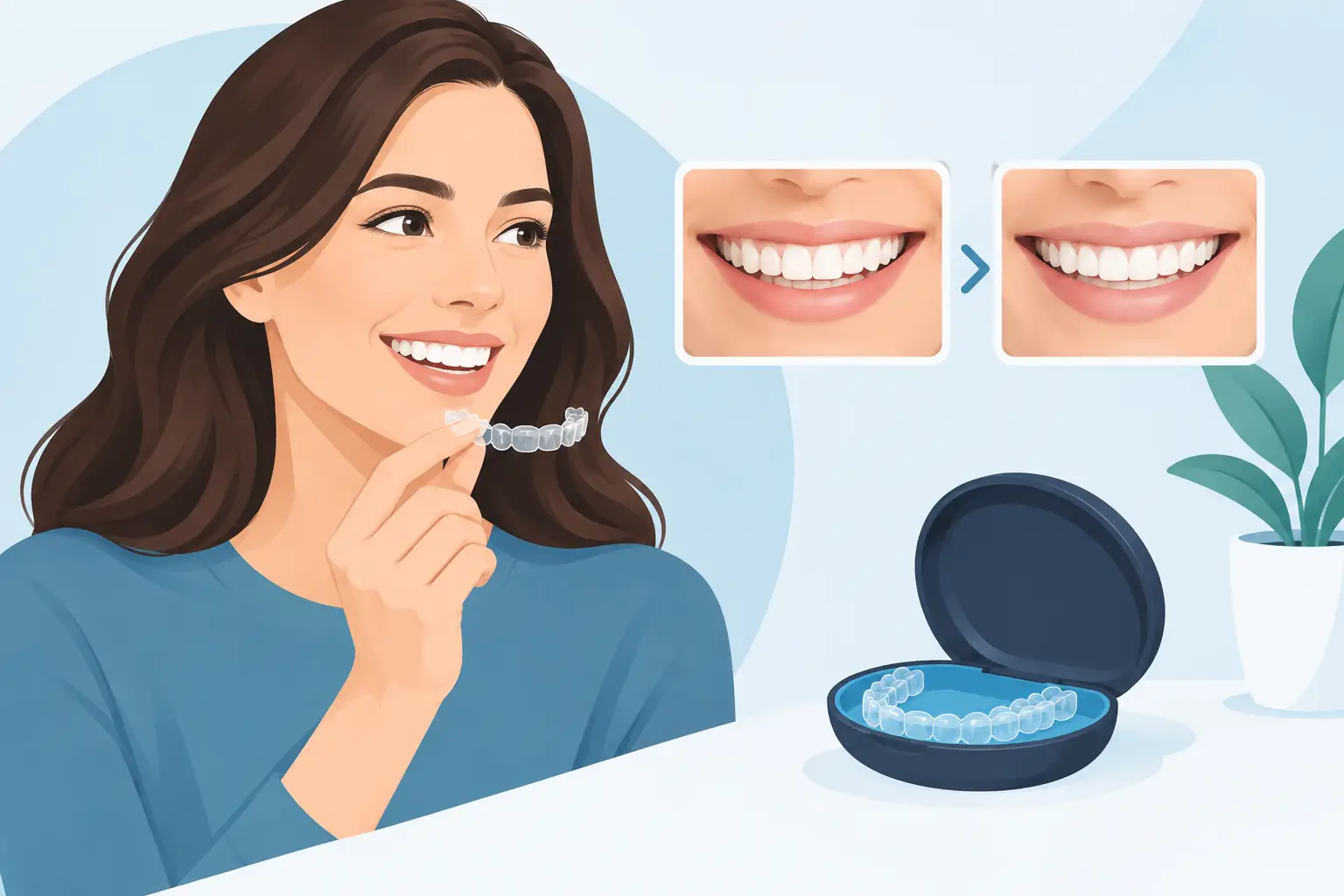
After approximately eight months of active treatment, including refinement, the patient achieved a visibly straighter smile with improved upper and lower alignment. The crowded lower incisors were easier to clean, the upper teeth appeared more even, and the smile showed a more balanced contour in photographs.
Just as importantly, the bite was evaluated for comfort and stability. The final goal was not an artificial, overly uniform appearance. It was a healthy, natural-looking smile in which the teeth fit together more predictably and the patient felt comfortable showing them.
The patient received clear retainers to wear after treatment. Retention is essential because teeth can shift throughout life, even after excellent orthodontic care. Most patients begin by wearing retainers full-time as directed, then transition to a nighttime schedule based on their individual needs and the dentist’s recommendation.
What This Case Shows About Invisalign Outcomes
The most meaningful lesson from this Invisalign treatment results case study is that good outcomes come from a partnership. Advanced digital planning and custom aligners provide the framework, but clinical oversight and patient consistency shape the final result.
Patients considering Invisalign should ask more than, “How fast will my teeth move?” It is equally helpful to ask whether the proposed plan addresses bite function, gum health, tooth movement limits, refinements, and retention. A shorter timeline is not always the better result if it overlooks details that affect comfort or stability.
Clear aligners may also need to be combined with other care. A patient with untreated gum disease, significant decay, missing teeth, severe bite concerns, or complex jaw alignment may need restorative, periodontal, or specialist care before or alongside orthodontic treatment. Personalized treatment planning protects both the appearance of the smile and the health behind it.
If you are considering Invisalign, start with a consultation that looks at the whole picture. A thoughtful evaluation can clarify what your smile needs, what treatment can realistically achieve, and what daily habits will help you protect your result long after the final aligner comes out.