
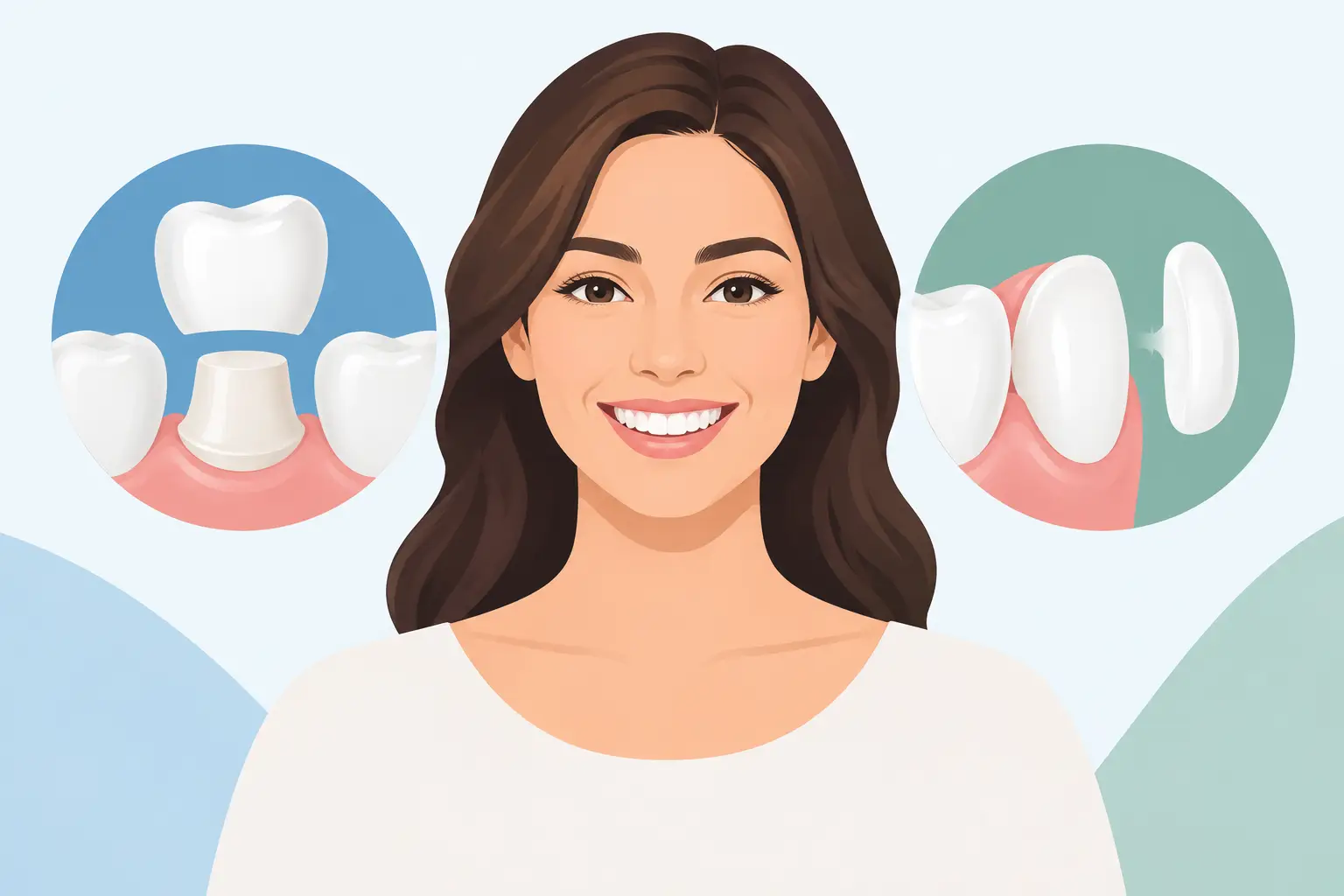
A front tooth that has darkened after a root canal needs a different solution than a healthy tooth with a small chip or uneven shape. That is why the question of crowns versus veneers cannot be answered by appearance alone. Both treatments can create a natural-looking, confident smile, but they protect and restore teeth in very different ways.
At Newport Beach Dentistry, treatment recommendations begin with the condition of the tooth, your bite, your goals, and what will support your oral health for years to come. The most attractive option is not always the most conservative option, and the most conservative option is not always strong enough. A thoughtful evaluation helps identify the right balance.
Crowns Versus Veneers: The Key Difference
A veneer covers the front surface of a tooth. It is a thin, custom-made shell, commonly crafted from porcelain, that changes the visible color, shape, size, or alignment of the tooth. Veneers are primarily a cosmetic treatment, although they can also restore minor areas of damage.
A crown covers the entire visible portion of a tooth above the gumline. It is designed to restore a tooth that has lost strength, structure, or stability. Modern crowns can be made from materials that closely resemble natural enamel, including high-quality ceramic and porcelain. While crowns can significantly improve appearance, their central purpose is protection.
Put simply, veneers are usually appropriate when the tooth is fundamentally healthy and the concern is what you see. Crowns are generally recommended when the tooth needs more complete structural support.
When Veneers May Be the Better Choice
Veneers can be an excellent option for patients who want to improve the appearance of one tooth or several teeth in the smile zone. They are often considered for stubborn discoloration that does not respond well to whitening, small chips, worn edges, minor gaps, uneven tooth shapes, or mild visual crowding.
Because a veneer is thin, the dentist usually removes a conservative amount of enamel from the front of the tooth to create room for the restoration. In some carefully selected cases, very minimal-preparation veneers may be possible. However, not every smile is a candidate for this approach. Adding material without sufficient preparation can make teeth appear bulky or affect how the bite comes together.
Porcelain veneers resist staining better than natural enamel and can reflect light in a remarkably lifelike way. They are customized for shade, translucency, contour, and length, which makes them especially appealing to patients seeking a refined but natural result.
Veneers do have limits. They are not intended to stabilize a tooth with a large filling, deep fracture, extensive decay, or significant loss of structure. They may also be a poor choice for someone who regularly clenches or grinds without first addressing that force. A protective nightguard may be recommended to help safeguard the veneers and the natural teeth.
Veneers require healthy foundations
A cosmetic concern should never hide an underlying dental issue. Before placing veneers, your dentist checks for cavities, gum disease, bite concerns, old restorations, and signs of enamel weakness. Healthy gums are especially important because the gumline frames every veneer. Treating inflammation first can make the final result more predictable and easier to maintain.
When a Crown Is the Better Choice
A crown is often recommended when a tooth is too weakened for a filling or veneer to provide reliable long-term support. Common reasons include a large existing filling, a cracked tooth, substantial decay, severe wear, a broken cusp, or treatment following a root canal. A crown may also be used to replace a missing tooth as part of a dental implant restoration or bridge.
To prepare a tooth for a crown, the dentist reshapes it around all sides so the crown can fit securely and function comfortably. This requires more reduction of natural tooth structure than veneer preparation. For that reason, placing a crown on a healthy tooth solely for a minor cosmetic imperfection is usually not the first choice.
Still, a crown can be a beautiful cosmetic restoration when it is clinically necessary. Advanced shade matching, digital imaging, and carefully selected materials allow crowns to blend with neighboring teeth. For front teeth, the goal is more than a bright color. The restoration must also reflect light naturally, support the lip, complement the gumline, and work with your facial features.
A crown protects what remains
Think of a crown as a protective cap that redistributes biting forces around a compromised tooth. It does not make the underlying tooth invincible, and the tooth can still develop decay at the margin if plaque accumulates. Yet when it is properly designed and cared for, a crown can preserve a tooth that might otherwise require extraction.
How Dentists Decide Between a Crown and a Veneer
The decision comes down to more than the size of a visible flaw. A comprehensive exam may include digital X-rays, photographs, intraoral images, and an assessment of your bite. These tools help reveal problems that are not obvious in the mirror, such as decay beneath an old filling, a crack, bone loss, or stress patterns caused by grinding.
Your dentist will consider how much healthy enamel remains. Veneers bond especially well to enamel, so a tooth with a strong enamel surface may be a good candidate. If much of that enamel is missing or the tooth has a large restoration, a crown may offer better retention and protection.
Bite is another major factor. Front teeth guide chewing and speech, and they can experience substantial pressure in certain bite patterns. Someone with a deep bite, edge-to-edge bite, or active grinding habit may need bite adjustment, orthodontic treatment, a nightguard, or a different restoration design before cosmetic work begins.
The appearance of neighboring teeth matters, too. A single crown or veneer should not look flat, opaque, or noticeably different from the teeth beside it. When several front teeth have discoloration, unevenness, or wear, treating more than one tooth may create a more balanced result. That does not mean every patient needs multiple veneers. Personalized planning is essential.
Durability, Maintenance, and Long-Term Expectations
Both crowns and porcelain veneers are durable, but neither is permanent. Their lifespan depends on material choice, oral hygiene, bite forces, diet, and regular dental care. Porcelain resists stains well, but it can chip or fracture under enough pressure. Crowns are also strong, yet they can wear, crack, loosen, or develop leakage at the edge over time.
Daily care is straightforward: brush twice a day with a nonabrasive toothpaste, clean between teeth daily, and maintain routine professional cleanings and exams. Avoid using teeth to open packages or bite hard objects. If you clench or grind, wearing a custom nightguard can be one of the most valuable ways to protect your investment.
Neither a veneer nor a crown can whiten after it is placed. If you are considering whitening your natural teeth, it is usually best to discuss it before selecting the final shade of a new restoration. This helps your dentist match the crown or veneer to the smile you want to maintain.
Cost Is Only One Part of the Decision
Costs vary based on the tooth being treated, the material used, the complexity of preparation, and whether additional care is needed first. Dental insurance may contribute differently depending on whether a restoration is considered medically necessary or primarily cosmetic. Veneers are often not covered, while crowns may receive partial coverage when they are needed to restore damaged tooth structure.
It is reasonable to consider budget, but choosing based on the lowest initial cost can create problems if the restoration does not match the tooth’s needs. A veneer placed on a severely weakened tooth may fail sooner. A crown placed where a conservative veneer would be appropriate may remove more healthy structure than necessary. The best value is treatment that supports both function and appearance.
Questions to Ask at Your Consultation
A productive consultation should leave you clear about why one option is being recommended. Ask whether the tooth has enough healthy enamel for a veneer, how your bite affects the treatment, what material is being proposed, and whether whitening or orthodontics should be considered first. You can also ask what maintenance will be needed and what alternatives may meet your goals.
The right restoration should feel like part of your smile, not a compromise you notice every time you speak or eat. Whether that means a conservative veneer or the full protection of a crown, a careful diagnosis gives you the confidence to choose treatment that looks natural and protects your health.